
Macoupin County Court Records After a Jail Arrest
The path from an arrest to a court record runs through the prosecutor. After a person is arrested and booked into the Macoupin County Jail, the case goes to the Macoupin County State's Attorney, who decides what formal charges to file. Those filed charges open a court case, and the court file becomes the lasting record of what happened. The booking sheet reflects the arresting agency's first allegations, while the court record reflects the charges the prosecutor actually pursues.
It helps to separate the two sides. The booking and custody side lives with the sheriff; for that, see jail inmate records for the roster channels and jail roster mugshots for booking photos. The court records after an arrest are different. They show the charges as filed, the hearing dates, the rulings, and the final disposition, and they are maintained by the Circuit Clerk rather than the jail.
The Circuit Clerk is the office that holds the case file.
The Macoupin County Circuit Clerk page describes the criminal division, online case search, and payment options.
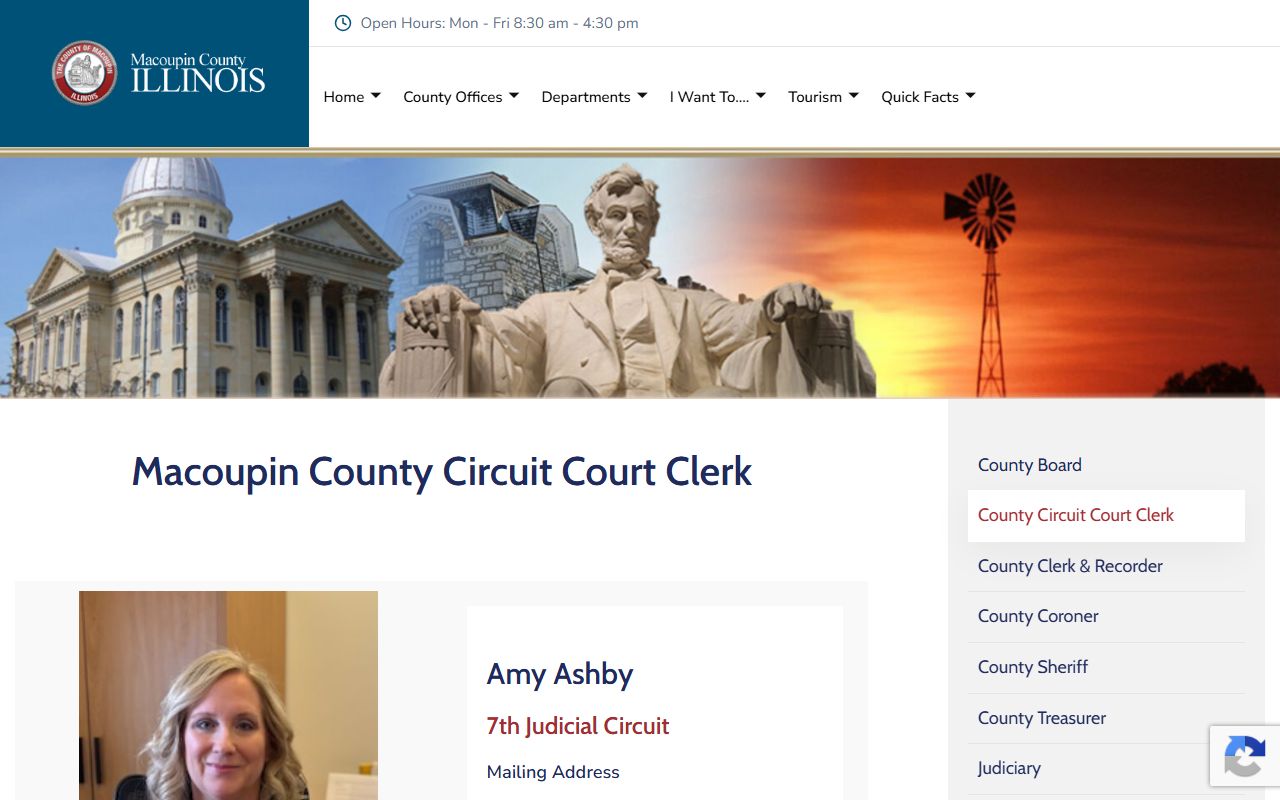
That office, led by Circuit Clerk Amy Ashby in the 7th Judicial Circuit, is where copies of court records after an arrest are obtained.
How to Find Macoupin County Court Records After an Arrest
Online case search for the county runs through Judici, which is linked from the county and the state courts directory. Judici lets you search a court case and read the charges, hearing dates, and dispositions once a case is filed. Some searches use a captcha or a session, so the exact form may load differently each visit.
- Open the Judici case search for Macoupin County, listed under court code IL059015J.
- Search by the defendant's name or by the case number if you have it.
- Open the case and read the charge list, the filing dates, and the hearing schedule.
- Check each charge's level and current status, and note the next court date.
The county case-search portal is the quickest way to pull a case after an arrest.
The Macoupin County Judici case search shows litigant information, criminal charges, dispositions, sentences, fines, and hearing dates.
The county courthouse is also listed in the state directory, which links additional court resources for the 7th Judicial Circuit.
The Illinois Courts directory page for the Macoupin County Courthouse connects the county court contacts and resources.
Charges Filed After a Macoupin County Arrest
Walking forward from the arrest, booking happens at the jail and then the charge record begins when the prosecutor files a charging document. The document type depends on the case. A complaint is common for misdemeanors, an information is the prosecutor's filing used for many felonies, and an indictment comes from a grand jury for serious felonies. Each one opens the case that becomes the court record.
| Complaint | Information | Indictment | |
|---|---|---|---|
| Filed By | Officer / Prosecutor | Prosecutor | Grand Jury |
| Common For | Misdemeanors | Many felonies | Serious felonies |
| Starts | The case | The case | The case |
The State's Attorney decides which path a case takes and can change course as the evidence develops.
The Macoupin County State's Attorney page explains that the office, led by Jordan J. Garrison, prosecutes criminal cases in the county.
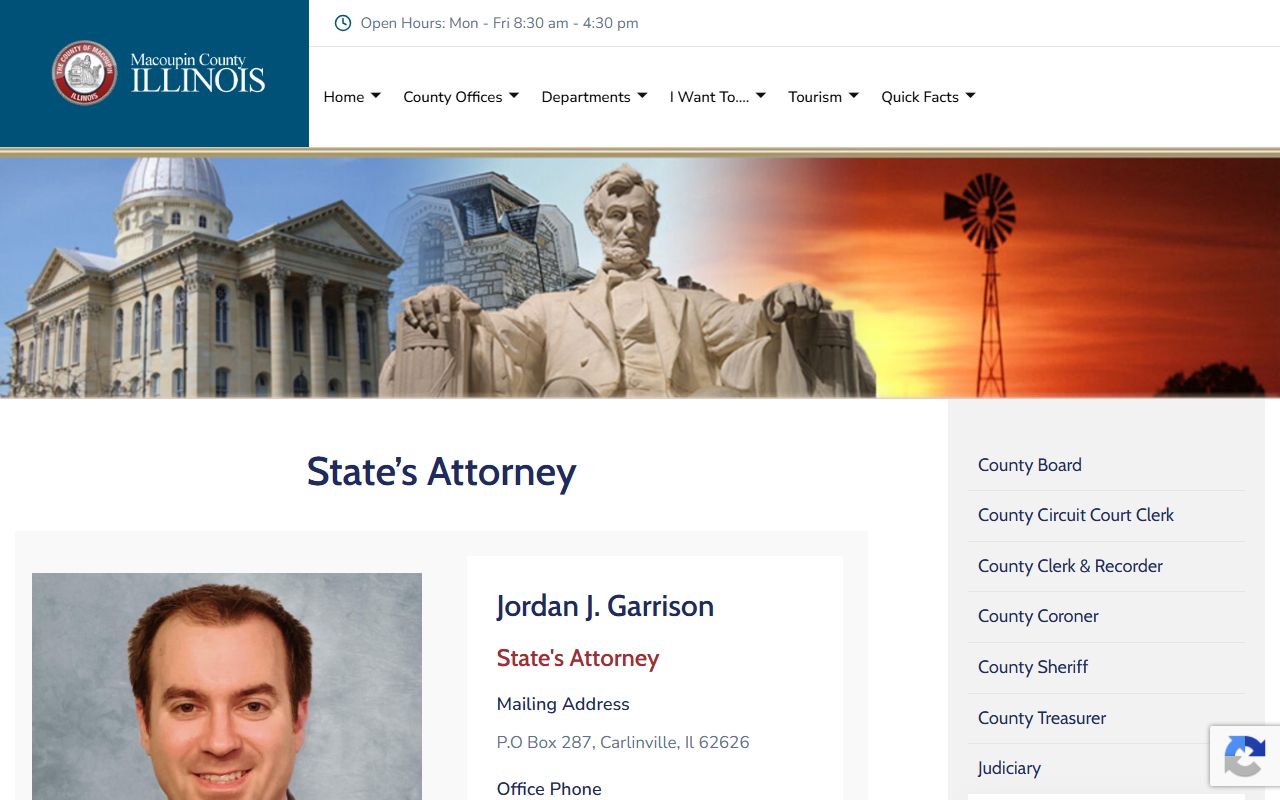
The prosecutor files charges, but the clerk keeps the file, so copies of the court record come from the Circuit Clerk rather than the State's Attorney.
Macoupin County Charge Status After an Arrest
Charges are not fixed once a case is filed. As a case moves, charges can be amended, reduced, added, dropped, or dismissed. The charges listed at booking on the jail side can also differ from the charges the prosecutor finally files. Reading the status on the court record tells you where a charge actually stands, which matters far more than the original arrest allegation.
| Status | What It Means |
|---|---|
| Pending | The charge is filed and the case is still moving through court. |
| Amended / Reduced | The charge was changed, often to a different count or a lower level. |
| Dismissed | The charge ended without a conviction. |
| Nolle Prosequi | The prosecutor chose not to pursue the charge. |
Bond and Release After a Macoupin County Arrest
Illinois changed how release works under the Pretrial Fairness Act, part of the SAFE-T Act. For new cases the state moved away from traditional cash bail and toward pretrial release conditions set by a judge. For eligible serious cases, the prosecutor can file a petition to detain a person before trial. So the older idea of simply posting a cash amount does not describe most current Macoupin County cases.
| Bond Type | How It Works |
|---|---|
| Cash Bond | Largely replaced for new Illinois cases by pretrial release conditions; may still touch older cases or previously deposited security. |
| Surety Bond | A third party guarantees appearance; a limited role under current Illinois pretrial rules. |
| PR / Own Recognizance | Release on a promise to appear, similar to release on conditions without money. |
| No-Bond Hold | Custody continues under a detention order or a hold from another agency. |
A person can stay in custody even when one charge looks releasable. A detention order, a warrant, a hold from another county, a state parole hold, or an immigration detainer can each keep someone in jail. For pretrial status, the court case on Judici, the Circuit Clerk's criminal division at 217-854-3211 ext. 921, or the jail are the places to confirm what is happening.
Warrants That Lead to an Arrest
Many bookings start with a warrant. The sheriff's office serves warrants issued at the request of the State's Attorney and the writs and summonses issued by the Circuit Court. There is no public online warrant list or most-wanted page for the county, so checking on a warrant means calling the sheriff or looking at the court case where a warrant event may appear.
Anyone who believes they have an active warrant is usually safest contacting an attorney or the court before appearing. The sheriff's office can be reached at 217-854-3135, and the court case on Judici can show a warrant, a failure to appear, and the next hearing date once those are entered. There is no single statewide public search for all Illinois warrants.
Charges vs. Convictions in Macoupin County
Being arrested and charged is not the same as being convicted. A charge is an accusation that the case is still testing. A conviction is the outcome, entered only after a plea or a finding of guilt. Both can appear in public records, but they mean very different things, and a charge on its own is not proof of guilt.
| Charge | Conviction | |
|---|---|---|
| Stage | Accusation | Verdict or plea |
| Burden of Proof | Probable cause | Beyond reasonable doubt |
| Public Record | Yes | Yes |
Sealed vs. Expunged Macoupin County Records
After a dismissal or an eligible outcome, a person may be able to clear an arrest record. Sealing hides the record from most public view, while expungement removes it so it is treated as though it never existed. Illinois sets the eligibility for each, and the route runs through the court rather than a private service. The record-clearing process is the proper way to address an old arrest record.
| Sealed | Expunged | |
|---|---|---|
| Visibility | Hidden from public | Destroyed / treated as never existed |
| Law Enforcement | Limited access | Very limited |
| Eligibility | Varies by charge and outcome under Illinois law | Often dismissals and certain eligible dispositions under Illinois law |
Background Check Considerations
A casual name search is not the same as a regulated background check. Formal background checks for jobs, housing, or credit must follow the federal Fair Credit Reporting Act and use a proper consumer reporting agency. Court records viewed for personal information do not carry those protections and should not be used to make those decisions.
Important: This site is not a consumer reporting agency under the FCRA, and its information may not be used for employment, housing, credit, or insurance screening.
Copies of Macoupin County Court Records
Court files are kept by the Circuit Clerk, so copies of court records after an arrest come from that office rather than from a county FOIA request. The clerk's criminal and traffic division handles misdemeanor, criminal, traffic, ordinance, and conservation cases and can be reached at 217-854-3211 extension 921. The office is at 201 East Main, P.O. Box 197, Carlinville, IL 62626-0197, with public hours of Monday through Friday, 8:30 a.m. to 4:30 p.m.
Some payments tied to a case, such as fines and fees, can be made online through the clerk's payment service, which adds a convenience fee shown before you finish. That online payment is for court costs and is not the same as posting any pretrial security at the jail. For the actual case file and certified copies, the clerk's counter or its published procedures are the route, since judicial records are obtained through the court rather than the executive-branch records law.
When a Case Moves Beyond the County Jail
A Macoupin County arrest does not always end in the county system. If a person is convicted of a felony and sentenced to prison, they leave the county jail for the Illinois Department of Corrections, and the case record stays with the court while custody shifts to the state. Federal cases follow a separate track, with pretrial custody often handled by the U.S. Marshals and sentenced custody by the federal Bureau of Prisons. The court record remains the place to confirm the charges and the final outcome no matter where the person is held afterward.
Restricted Court Records After an Arrest in Macoupin County
Not every court record after an arrest is open to the public. Juvenile cases are restricted, sealed or expunged charges drop out of public view, and records tied to an ongoing investigation can be withheld. Court files are handled by the judicial branch and are obtained through the Circuit Clerk's procedures rather than an executive-branch records request, because the open-records law treats judicial records differently. When a record is not visible online, the Circuit Clerk's criminal division is the office to ask.